 cd7686baa2
Adds a keyboard shortcut feature (Rust matcher + Dart UI + cross-language
  parity tests) that lets users bind combinations like Ctrl+Alt+Shift+P to
  session actions. Bindings are stored in LocalConfig under
  `keyboard-shortcuts`; the matcher gates dispatch on `enabled` and
  `pass_through` flags so flipping the master switch off is a hard stop.

  Wire-up summary:
  - src/keyboard/shortcuts.rs: matcher, default bindings, parity test against
    flutter/test/fixtures/default_keyboard_shortcuts.json
  - src/keyboard.rs: shortcut intercept in process_event{,_with_session},
    feature-gated to `flutter`; runs before key swapping so users bind to
    physical keys
  - src/flutter_ffi.rs: main_reload_keyboard_shortcuts +
    main_get_default_keyboard_shortcuts; reload_from_config seeded in main_init
  - flutter/lib/common/widgets/keyboard_shortcuts/: shared config page body,
    recording dialog, shortcut display formatter, action group registry
  - flutter/lib/desktop/pages/desktop_keyboard_shortcuts_page.dart and
    flutter/lib/mobile/pages/mobile_keyboard_shortcuts_page.dart: platform
    shells around the shared body
  - flutter/lib/models/shortcut_model.dart: per-session ShortcutModel +
    registerSessionShortcutActions for actions with no toolbar TToggleMenu /
    TRadioMenu (fullscreen, switch display/tab, close tab, voice call, etc.)
  - flutter/lib/common/widgets/toolbar.dart: optional `actionId` field on
    TToggleMenu / TRadioMenu, plus per-helper auto-register pass that wires
    tagged entries' existing onChanged into the ShortcutModel
  - flutter/test/keyboard_shortcuts_test.dart + fixtures: cross-language
    parity (default bindings, supported key vocabulary)

  Design principles applied during review:

  1. Additions are fine; modifications to original logic must be deliberate.
     Tagging an existing TToggleMenu entry with `actionId:` is an addition.
     Rewriting its onChanged to satisfy a new contract is a modification —
     and was reverted for every case where the original click behavior was
     working. Four closures were touched and then reverted (mobile View
     Mode, Privacy mode multi-impl, Relative mouse mode, Reverse mouse
     wheel); their shortcuts are wired via standalone closures in
     shortcut_model.dart instead.

  2. Toolbar auto-register is reserved for entries whose onChanged is
     inherently self-flipping — typically `sessionToggleOption(name)` where
     the named option is flipped in place and the input bool is unused. The
     register pass passes `!menu.value` from registration time, which is
     harmless under self-flipping but wrong for closures that consume the
     input bool directly. Tagging a non-self-flipping entry forces a closure
     rewrite; choose non-toolbar registration in that case.

  3. When shortcuts are disabled, toolbar behavior must be bit-for-bit
     unchanged. The matcher's `enabled`-gate already guarantees no
     dispatch; the auto-register pass is left unconditional (its only effect
     is HashMap operations on a separate ShortcutModel) so mid-session
     enable works without a reconnect. The trade-off is intentional and
     documented at the top of toolbarControls.

  4. Comments stay terse. Rationale lives in one place — the doc comment of
     the helper or registration site, not duplicated at every call site.

  5. Where an existing helper needs a new optional behavior (e.g.
     `_OptionCheckBox` gaining a tooltip slot), the new branch must reduce
     to byte-identical output for existing callers (`trailing == null`
     case → original `Expanded(Text)` layout). Verified.

  6. Action IDs and labels stay consistent. Renamed `reset_cursor` →
     `reset_canvas` so the action ID matches its user-facing label
     ("Reset canvas") and capability flag.

  Out-of-scope but included:
  - AGENTS.md: documents flutter_rust_bridge no-codegen workflow and the
    Web target's hand-written TS client, since both are load-bearing for
    any new FFI work.
  - remote_toolbar.dart: i18n fix for the per-monitor tooltip ("All
    monitors" / "Monitor #N"), unrelated to shortcuts but kept here.

Build •
Docker •
Structure •
Snapshot
[Українська] | [česky] | [中文] | [Magyar] | [Español] | [فارسی] | [Français] | [Deutsch] | [Polski] | [Indonesian] | [Suomi] | [മലയാളം] | [日本語] | [Nederlands] | [Italiano] | [Русский] | [Português (Brasil)] | [Esperanto] | [한국어] | [العربي] | [Tiếng Việt] | [Dansk] | [Ελληνικά] | [Türkçe] | [Norsk] | [Română]
We need your help to translate this README, RustDesk UI and RustDesk Doc to your native language
Caution
Misuse Disclaimer:
The developers of RustDesk do not condone or support any unethical or illegal use of this software. Misuse, such as unauthorized access, control or invasion of privacy, is strictly against our guidelines. The authors are not responsible for any misuse of the application.
Chat with us: Discord | Twitter | Reddit | YouTube

Yet another remote desktop solution, written in Rust. Works out of the box with no configuration required. You have full control of your data, with no concerns about security. You can use our rendezvous/relay server, set up your own, or write your own rendezvous/relay server.
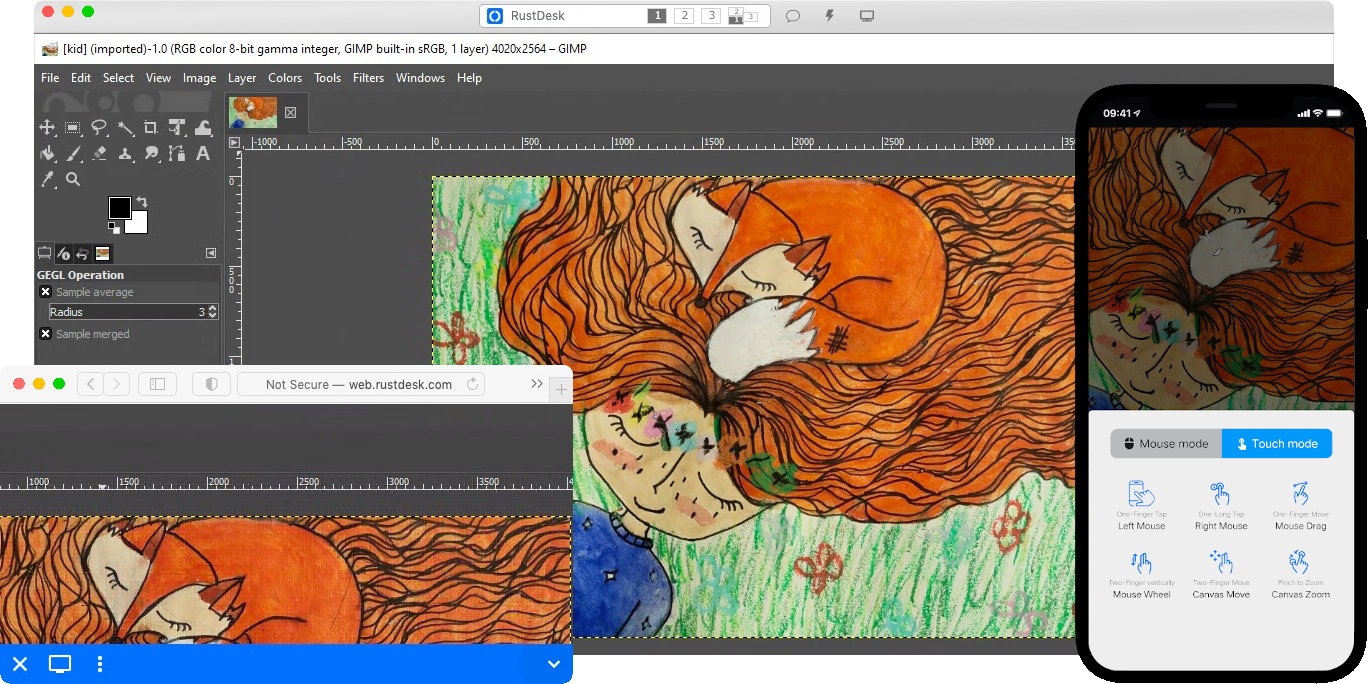
RustDesk welcomes contribution from everyone. See CONTRIBUTING.md for help getting started.

Dependencies
Desktop versions use Flutter or Sciter (deprecated) for GUI, this tutorial is for Sciter only, since it is easier and more friendly to start. Check out our CI for building Flutter version.
Please download Sciter dynamic library yourself.
Raw Steps to build
-
Prepare your Rust development env and C++ build env
-
Install vcpkg, and set
VCPKG_ROOTenv variable correctly- Windows: vcpkg install libvpx:x64-windows-static libyuv:x64-windows-static opus:x64-windows-static aom:x64-windows-static
- Linux/macOS: vcpkg install libvpx libyuv opus aom
-
run
cargo run
Build
How to Build on Linux
Ubuntu 18 (Debian 10)
sudo apt install -y zip g++ gcc git curl wget nasm yasm libgtk-3-dev clang libxcb-randr0-dev libxdo-dev \
        libxfixes-dev libxcb-shape0-dev libxcb-xfixes0-dev libasound2-dev libpulse-dev cmake make \
        libclang-dev ninja-build libgstreamer1.0-dev libgstreamer-plugins-base1.0-dev libpam0g-dev
openSUSE Tumbleweed
sudo zypper install gcc-c++ git curl wget nasm yasm gcc gtk3-devel clang libxcb-devel libXfixes-devel cmake alsa-lib-devel gstreamer-devel gstreamer-plugins-base-devel xdotool-devel pam-devel
Fedora 28 (CentOS 8)
sudo yum -y install gcc-c++ git curl wget nasm yasm gcc gtk3-devel clang libxcb-devel libxdo-devel libXfixes-devel pulseaudio-libs-devel cmake alsa-lib-devel gstreamer1-devel gstreamer1-plugins-base-devel pam-devel
Arch (Manjaro)
sudo pacman -Syu --needed unzip git cmake gcc curl wget yasm nasm zip make pkg-config clang gtk3 xdotool libxcb libxfixes alsa-lib pipewire
Install vcpkg
git clone https://github.com/microsoft/vcpkg
cd vcpkg
git checkout 2023.04.15
cd ..
vcpkg/bootstrap-vcpkg.sh
export VCPKG_ROOT=$HOME/vcpkg
vcpkg/vcpkg install libvpx libyuv opus aom
Fix libvpx (For Fedora)
cd vcpkg/buildtrees/libvpx/src
cd *
./configure
sed -i 's/CFLAGS+=-I/CFLAGS+=-fPIC -I/g' Makefile
sed -i 's/CXXFLAGS+=-I/CXXFLAGS+=-fPIC -I/g' Makefile
make
cp libvpx.a $HOME/vcpkg/installed/x64-linux/lib/
cd
Build
curl --proto '=https' --tlsv1.2 -sSf https://sh.rustup.rs | sh
source $HOME/.cargo/env
git clone --recurse-submodules https://github.com/rustdesk/rustdesk
cd rustdesk
mkdir -p target/debug
wget https://raw.githubusercontent.com/c-smile/sciter-sdk/master/bin.lnx/x64/libsciter-gtk.so
mv libsciter-gtk.so target/debug
VCPKG_ROOT=$HOME/vcpkg cargo run
How to build with Docker
Begin by cloning the repository and building the Docker container:
git clone https://github.com/rustdesk/rustdesk
cd rustdesk
git submodule update --init --recursive
docker build -t "rustdesk-builder" .
Then, each time you need to build the application, run the following command:
docker run --rm -it -v $PWD:/home/user/rustdesk -v rustdesk-git-cache:/home/user/.cargo/git -v rustdesk-registry-cache:/home/user/.cargo/registry -e PUID="$(id -u)" -e PGID="$(id -g)" rustdesk-builder
Note that the first build may take longer before dependencies are cached, subsequent builds will be faster. Additionally, if you need to specify different arguments to the build command, you may do so at the end of the command in the <OPTIONAL-ARGS> position. For instance, if you wanted to build an optimized release version, you would run the command above followed by --release. The resulting executable will be available in the target folder on your system, and can be run with:
target/debug/rustdesk
Or, if you're running a release executable:
target/release/rustdesk
Please ensure that you run these commands from the root of the RustDesk repository, or the application may not find the required resources. Also note that other cargo subcommands such as install or run are not currently supported via this method as they would install or run the program inside the container instead of the host.
File Structure
- libs/hbb_common: video codec, config, tcp/udp wrapper, protobuf, fs functions for file transfer, and some other utility functions
- libs/scrap: screen capture
- libs/enigo: platform specific keyboard/mouse control
- libs/clipboard: file copy and paste implementation for Windows, Linux, macOS.
- src/ui: obsolete Sciter UI (deprecated)
- src/server: audio/clipboard/input/video services, and network connections
- src/client.rs: start a peer connection
- src/rendezvous_mediator.rs: Communicate with rustdesk-server, wait for remote direct (TCP hole punching) or relayed connection
- src/platform: platform specific code
- flutter: Flutter code for desktop and mobile
- flutter/web/js: JavaScript for Flutter web client