 6ad56075d6
* Drag whole toolbar; snap to all four edges

Today the drag handle on the remote-session toolbar repositions only
the handle row -- the icons themselves stay centered at the top. This
change applies the position to the entire toolbar wrapper so dragging
the handle moves the whole thing, and extends snapping from top-only
to any of the four window edges.

When docked left/right the toolbar reflows vertically. A live ghost
preview shows where the toolbar will land while you drag, with a small
hysteresis bias to keep the preview from flickering near corners.

The legacy 'remote-menubar-drag-x' session option is read as a fallback
on first load so existing users keep their saved horizontal position;
new option keys are 'remote-menubar-edge' and 'remote-menubar-frac'.

Tested locally on Windows. macOS / Linux / web desktop use the same
shared widget with no platform-specific calls, but I did not verify
them.

* Load edge independently and clamp loaded fraction

Addresses CodeRabbit review on #15051: parse the saved edge regardless
of whether the new fraction option is present so a partial write of
frac doesn't reset the toolbar back to top, and clamp the loaded
fraction to the kOptionRemoteMenubarDragLeft/Right contract so a
corrupted or out-of-range saved value can't bypass the bounds until
the user drags again.

* Require edge activation zone to switch dock; preserve horizontal slide

Per review feedback on #15051: nearest-edge-wins made a low-intent
horizontal slide too easy to escalate into a high-impact orientation
change (vertical reflow on left/right dock). The default drag now
keeps the toolbar on its current dock edge and just updates the
fraction along that edge -- the prior horizontal-slide behavior.

An alternate edge is only previewed/committed when the cursor enters
its 32 px activation zone; once previewed, the cursor has to move
back 64 px before reverting (hysteresis at the zone boundary).

* Gate multi-edge docking behind a settings toggle; default = horizontal slide

Replaces the activation-zone approach with an explicit opt-in setting
in Settings -> Other ("Allow docking remote toolbar to any window
edge"). This addresses the concern that a low-intent horizontal drag
shouldn't be able to trigger a high-impact orientation change, while
still letting users who want multi-edge docking opt in cleanly.

Default (toggle off):
  - The original horizontal slide is preserved.
  - The bug fix from the first commit still applies: dragging the
    handle moves the whole toolbar, and the position persists across
    collapse/expand (no more re-center on re-open).
  - Draggable is axis-locked to horizontal so the feedback widget
    stays on the top line during drag.

Opt-in (toggle on):
  - Full nearest-edge wins with the live preview ghost and corner
    hysteresis; toolbar reflows vertically on left/right docks.
  - Draggable is unlocked for 2D drag.

Reads the option via mainGetLocalBoolOptionSync so the toolbar's
default state matches what the settings checkbox shows; the option
key uses the allow- prefix so unset defaults to off.

Takes effect on next session (setting is read at session init).

The setting key (allow-multi-edge-toolbar-dock) is read by the
existing local-options machinery and persists per-install without
needing to be registered in libs/hbb_common's KEYS_LOCAL_SETTINGS.
Can add that registration in a parallel hbb_common PR if preferred.

* Fix remote toolbar drag positioning & persistence

Align drag fraction calculation with the toolbar's actual travel range,
keep preview sizing stable during drag, and preserve legacy horizontal
position storage when multi-edge docking is disabled.

Signed-off-by: fufesou <linlong1266@gmail.com>

* Remote toolbar snap edges

1. Translations
2. Apply option to remote windows on changed

Signed-off-by: fufesou <linlong1266@gmail.com>

* fix: avoid remote toolbar docking jumps on setting reload

Signed-off-by: fufesou <linlong1266@gmail.com>

* Fix remote toolbar docking updates and drag sync

Signed-off-by: fufesou <linlong1266@gmail.com>

* refact: translation key

Signed-off-by: fufesou <linlong1266@gmail.com>

* feat(toolbar-snap-edges): test web

Signed-off-by: fufesou <linlong1266@gmail.com>

* Fix remote toolbar docking sync and vertical layout

Signed-off-by: fufesou <linlong1266@gmail.com>

* Fix remote toolbar monitor controls on side docks

Signed-off-by: fufesou <linlong1266@gmail.com>

---------

Signed-off-by: fufesou <linlong1266@gmail.com>
Co-authored-by: fufesou <linlong1266@gmail.com>

Build •
Docker •
Structure •
Snapshot
[Українська] | [česky] | [中文] | [Magyar] | [Español] | [فارسی] | [Français] | [Deutsch] | [Polski] | [Indonesian] | [Suomi] | [മലയാളം] | [日本語] | [Nederlands] | [Italiano] | [Русский] | [Português (Brasil)] | [Esperanto] | [한국어] | [العربي] | [Tiếng Việt] | [Dansk] | [Ελληνικά] | [Türkçe] | [Norsk] | [Română]
We need your help to translate this README, RustDesk UI and RustDesk Doc to your native language
Caution
Misuse Disclaimer:
The developers of RustDesk do not condone or support any unethical or illegal use of this software. Misuse, such as unauthorized access, control or invasion of privacy, is strictly against our guidelines. The authors are not responsible for any misuse of the application.
Chat with us: Discord | Twitter | Reddit | YouTube

Yet another remote desktop solution, written in Rust. Works out of the box with no configuration required. You have full control of your data, with no concerns about security. You can use our rendezvous/relay server, set up your own, or write your own rendezvous/relay server.
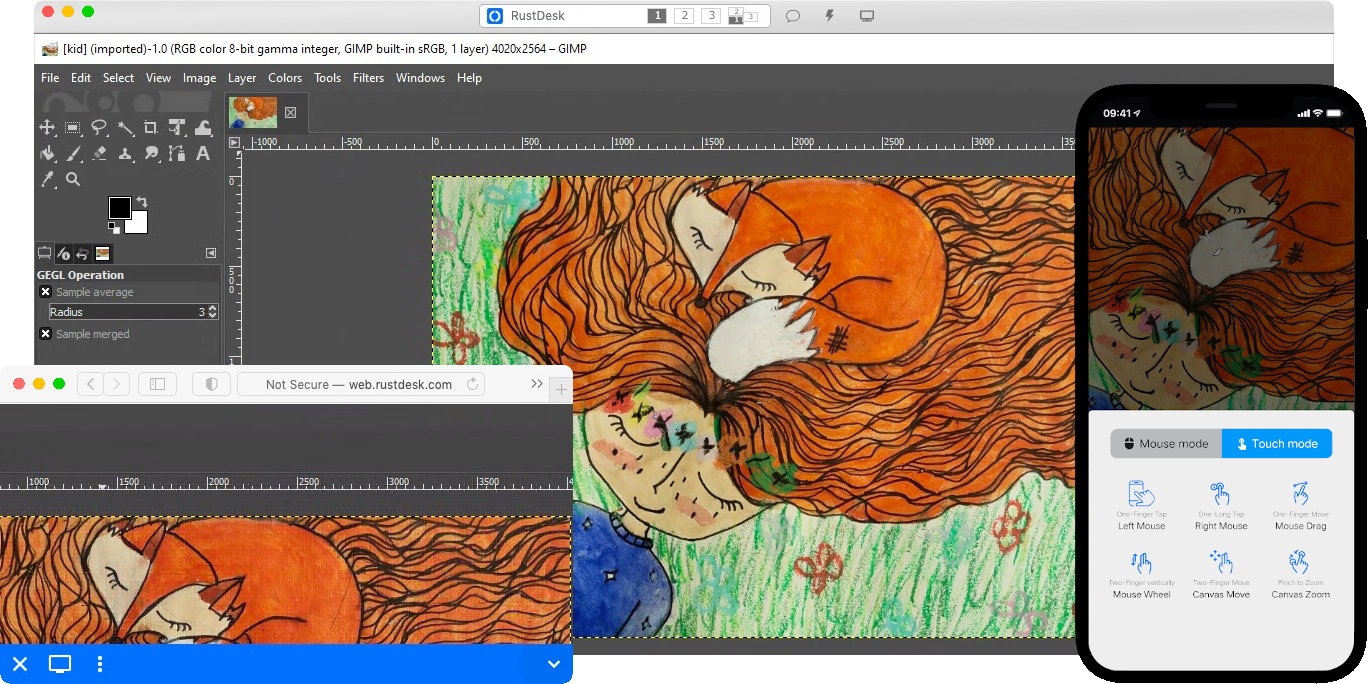
RustDesk welcomes contribution from everyone. See CONTRIBUTING.md for help getting started.

Dependencies
Desktop versions use Flutter or Sciter (deprecated) for GUI, this tutorial is for Sciter only, since it is easier and more friendly to start. Check out our CI for building Flutter version.
Please download Sciter dynamic library yourself.
Raw Steps to build
-
Prepare your Rust development env and C++ build env
-
Install vcpkg, and set
VCPKG_ROOTenv variable correctly- Windows: vcpkg install libvpx:x64-windows-static libyuv:x64-windows-static opus:x64-windows-static aom:x64-windows-static
- Linux/macOS: vcpkg install libvpx libyuv opus aom
-
run
cargo run
Build
How to Build on Linux
Ubuntu 18 (Debian 10)
sudo apt install -y zip g++ gcc git curl wget nasm yasm libgtk-3-dev clang libxcb-randr0-dev libxdo-dev \
        libxfixes-dev libxcb-shape0-dev libxcb-xfixes0-dev libasound2-dev libpulse-dev cmake make \
        libclang-dev ninja-build libgstreamer1.0-dev libgstreamer-plugins-base1.0-dev libpam0g-dev
openSUSE Tumbleweed
sudo zypper install gcc-c++ git curl wget nasm yasm gcc gtk3-devel clang libxcb-devel libXfixes-devel cmake alsa-lib-devel gstreamer-devel gstreamer-plugins-base-devel xdotool-devel pam-devel
Fedora 28 (CentOS 8)
sudo yum -y install gcc-c++ git curl wget nasm yasm gcc gtk3-devel clang libxcb-devel libxdo-devel libXfixes-devel pulseaudio-libs-devel cmake alsa-lib-devel gstreamer1-devel gstreamer1-plugins-base-devel pam-devel
Arch (Manjaro)
sudo pacman -Syu --needed unzip git cmake gcc curl wget yasm nasm zip make pkg-config clang gtk3 xdotool libxcb libxfixes alsa-lib pipewire
Install vcpkg
git clone https://github.com/microsoft/vcpkg
cd vcpkg
git checkout 2023.04.15
cd ..
vcpkg/bootstrap-vcpkg.sh
export VCPKG_ROOT=$HOME/vcpkg
vcpkg/vcpkg install libvpx libyuv opus aom
Fix libvpx (For Fedora)
cd vcpkg/buildtrees/libvpx/src
cd *
./configure
sed -i 's/CFLAGS+=-I/CFLAGS+=-fPIC -I/g' Makefile
sed -i 's/CXXFLAGS+=-I/CXXFLAGS+=-fPIC -I/g' Makefile
make
cp libvpx.a $HOME/vcpkg/installed/x64-linux/lib/
cd
Build
curl --proto '=https' --tlsv1.2 -sSf https://sh.rustup.rs | sh
source $HOME/.cargo/env
git clone --recurse-submodules https://github.com/rustdesk/rustdesk
cd rustdesk
mkdir -p target/debug
wget https://raw.githubusercontent.com/c-smile/sciter-sdk/master/bin.lnx/x64/libsciter-gtk.so
mv libsciter-gtk.so target/debug
VCPKG_ROOT=$HOME/vcpkg cargo run
How to build with Docker
Begin by cloning the repository and building the Docker container:
git clone https://github.com/rustdesk/rustdesk
cd rustdesk
git submodule update --init --recursive
docker build -t "rustdesk-builder" .
Then, each time you need to build the application, run the following command:
docker run --rm -it -v $PWD:/home/user/rustdesk -v rustdesk-git-cache:/home/user/.cargo/git -v rustdesk-registry-cache:/home/user/.cargo/registry -e PUID="$(id -u)" -e PGID="$(id -g)" rustdesk-builder
Note that the first build may take longer before dependencies are cached, subsequent builds will be faster. Additionally, if you need to specify different arguments to the build command, you may do so at the end of the command in the <OPTIONAL-ARGS> position. For instance, if you wanted to build an optimized release version, you would run the command above followed by --release. The resulting executable will be available in the target folder on your system, and can be run with:
target/debug/rustdesk
Or, if you're running a release executable:
target/release/rustdesk
Please ensure that you run these commands from the root of the RustDesk repository, or the application may not find the required resources. Also note that other cargo subcommands such as install or run are not currently supported via this method as they would install or run the program inside the container instead of the host.
File Structure
- libs/hbb_common: video codec, config, tcp/udp wrapper, protobuf, fs functions for file transfer, and some other utility functions
- libs/scrap: screen capture
- libs/enigo: platform specific keyboard/mouse control
- libs/clipboard: file copy and paste implementation for Windows, Linux, macOS.
- src/ui: obsolete Sciter UI (deprecated)
- src/server: audio/clipboard/input/video services, and network connections
- src/client.rs: start a peer connection
- src/rendezvous_mediator.rs: Communicate with rustdesk-server, wait for remote direct (TCP hole punching) or relayed connection
- src/platform: platform specific code
- flutter: Flutter code for desktop and mobile
- flutter/web/js: JavaScript for Flutter web client