 26c840f6e6
ICE gathered every IPv6 address on every interface. Beside the temporary
address that privacy extensions rotate, a prefix usually carries a stable
one, often derived from the MAC, that the OS never picks as a source: a host
candidate for it hands the peer an identifier that outlives every rotation
and that nothing else this machine sends out ever shows.

RFC 8445 §5.1.1.1 has the trackable addresses of an interface and prefix
left out once a privacy one is gathered. There is no portable way to tell
the two apart, so the fork's `local_interfaces` stands in for that rule
with a best-effort approximation: of an interface's addresses in one
prefix, it asks the OS which one it sends from - a UDP `connect` inside the
group's own prefix, nothing sent, nothing outside this machine's own
prefixes involved - and if the answer is one of them, keeps that one alone.
If the answer is none of them, the whole group is kept, as it was: the
probe is bound to no interface, so where Ethernet and Wi-Fi share a LAN the
route picks one of them and the answer for the other is an address it does
not hold, and the enumeration order would be no better a guess - on macOS
its first address is the stable one. Every other interface and prefix keeps
its address, a VPN's unique-local one among them. Two static addresses in
one prefix keep one, the recorded price of the stand-in; the interface a
shared prefix's route bypasses keeps both of its addresses, a gap the
stand-in leaves open rather than a regression.

The Windows enumeration, which named every adapter "" with no mask, now
carries the adapter's name and on-link prefix, without which Ethernet and
Wi-Fi on one LAN would have been a single group. That reaches IPv4 too:
its addresses carry the adapter's name and mask where they were "" at /32,
so the candidates gathered are the same but `interface_filter` sees the
real names. hbb_common is untouched: its fe80::/10 filter still applies to
what the fork keeps.

Two more fork commits ride along, found by the same review. SCTP never
reported a DATA chunk received again: `handle_data` asks `can_push` before
`push`, and `push` was where a duplicate was noted, so the no-cwnd sender's
reordering window, which widens on reported duplicates, never heard of one
from another of these endpoints; and the SACK, its gap blocks and now its
duplicates unbounded, could outgrow the MTU the DATA chunks keep to under a
thousand chunks in flight with holes among them. Duplicates are now listed
and SACKed at once (RFC 9260 §6.2), and the SACK reports the lowest gap
blocks that fit (§6.7). And the Windows adapter struct, split into nested
parts, read `Ipv6IfIndex` eight bytes late on x64 - only into a scope id
that `Interface::convert` drops, so nothing gathered wrongly, but the field
an interface-bound probe would need; it is flat now, with a compile-time
check written for Rust 1.75, the version this crate builds with -
`offset_of!` would have wanted 1.77.

rustdesk-org/webrtc 80d5a20..49c89bd8, six commits: the heuristic, the
fail-open it grew in review, its comments brought in line with that, the
SCTP duplicates and SACK bound, the flat Windows adapter struct, and its
check made to build on 1.75.

Co-Authored-By: Claude Fable 5.1 <noreply@anthropic.com>
Claude-Session: https://claude.ai/code/session_019aokqJuhjvB3kijXtAg5Ns

Build •
Docker •
Structure •
Screenshots
[Українська] | [česky] | [中文] | [Magyar] | [Español] | [فارسی] | [Français] | [Deutsch] | [Polski] | [Indonesian] | [Suomi] | [മലയാളം] | [日本語] | [Nederlands] | [Italiano] | [Русский] | [Português (Brasil)] | [Esperanto] | [한국어] | [العربي] | [Tiếng Việt] | [Dansk] | [Ελληνικά] | [Türkçe] | [Norsk] | [Română]
We need your help to translate this README, RustDesk UI and RustDesk Doc to your native language
Caution
Misuse Disclaimer:
The developers of RustDesk do not condone or support any unethical or illegal use of this software. Misuse, such as unauthorized access, control or invasion of privacy, is strictly against our guidelines. The authors are not responsible for any misuse of the application.
Chat with us: Discord | Twitter | Reddit | YouTube

Yet another remote desktop solution, written in Rust. Works out of the box with no configuration required. You have full control of your data, with no concerns about security. You can use our rendezvous/relay server, set up your own, or write your own rendezvous/relay server.
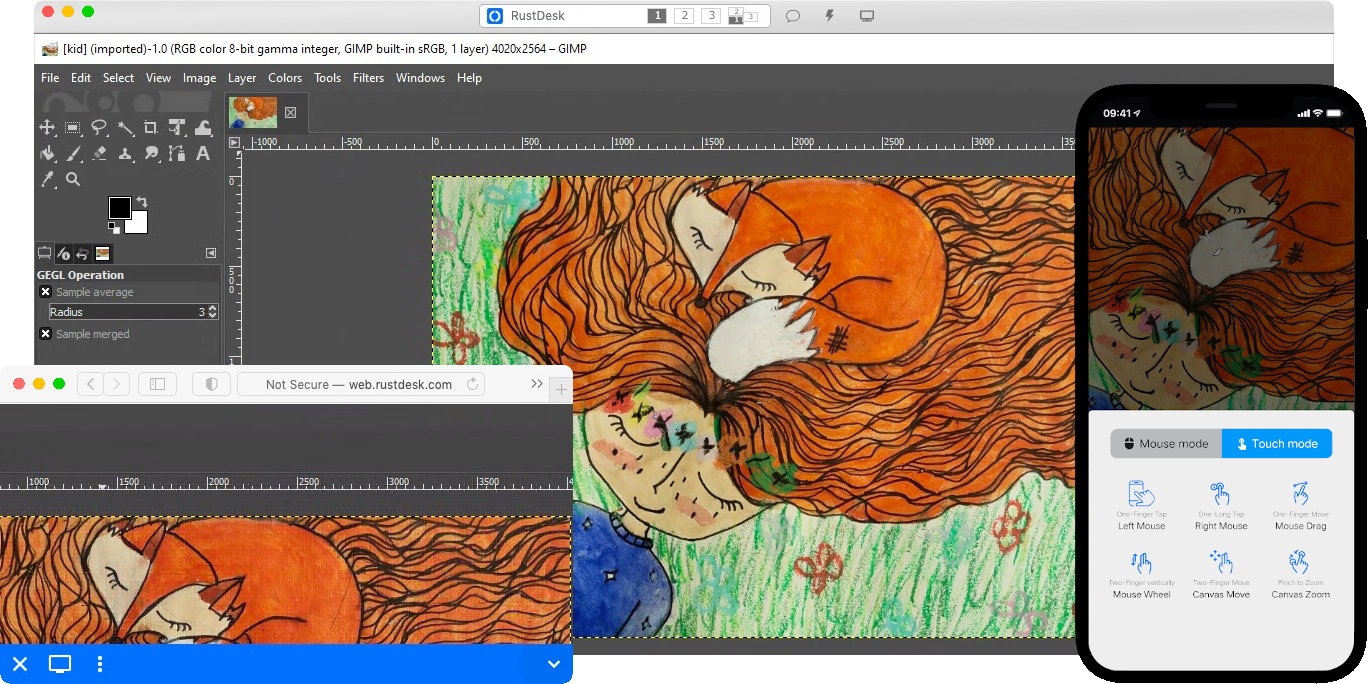
RustDesk welcomes contribution from everyone. See CONTRIBUTING.md for help getting started.

Dependencies
Desktop versions use Flutter or Sciter (deprecated) for GUI. This tutorial is for Sciter only, since it is easier and more friendly to start. Check out our CI for building the Flutter version.
Please download Sciter dynamic library yourself.
Raw Steps to build
-
Prepare your Rust development env and C++ build env
-
Install vcpkg, and set
VCPKG_ROOTenv variable correctly- Windows: vcpkg install libvpx:x64-windows-static libyuv:x64-windows-static opus:x64-windows-static aom:x64-windows-static
- Linux/macOS: vcpkg install libvpx libyuv opus aom
-
run
cargo run
Build
How to Build on Linux
Ubuntu 18 (Debian 10)
sudo apt install -y zip g++ gcc git curl wget nasm yasm libgtk-3-dev clang libxcb-randr0-dev libxdo-dev \
        libxfixes-dev libxcb-shape0-dev libxcb-xfixes0-dev libasound2-dev libpulse-dev cmake make \
        libclang-dev ninja-build libgstreamer1.0-dev libgstreamer-plugins-base1.0-dev
openSUSE Tumbleweed
sudo zypper install gcc-c++ git curl wget nasm yasm gcc gtk3-devel clang libxcb-devel libXfixes-devel cmake alsa-lib-devel gstreamer-devel gstreamer-plugins-base-devel xdotool-devel
Fedora 28 (CentOS 8)
sudo yum -y install gcc-c++ git curl wget nasm yasm gcc gtk3-devel clang libxcb-devel libxdo-devel libXfixes-devel pulseaudio-libs-devel cmake alsa-lib-devel gstreamer1-devel gstreamer1-plugins-base-devel
Arch (Manjaro)
sudo pacman -Syu --needed unzip git cmake gcc curl wget yasm nasm zip make pkg-config clang gtk3 xdotool libxcb libxfixes alsa-lib pipewire
Install vcpkg
git clone https://github.com/microsoft/vcpkg
cd vcpkg
git checkout 2023.04.15
cd ..
vcpkg/bootstrap-vcpkg.sh
export VCPKG_ROOT=$HOME/vcpkg
vcpkg/vcpkg install libvpx libyuv opus aom
Fix libvpx (For Fedora)
cd vcpkg/buildtrees/libvpx/src
cd *
./configure
sed -i 's/CFLAGS+=-I/CFLAGS+=-fPIC -I/g' Makefile
sed -i 's/CXXFLAGS+=-I/CXXFLAGS+=-fPIC -I/g' Makefile
make
cp libvpx.a $HOME/vcpkg/installed/x64-linux/lib/
cd
Build
curl --proto '=https' --tlsv1.2 -sSf https://sh.rustup.rs | sh
source $HOME/.cargo/env
git clone --recurse-submodules https://github.com/rustdesk/rustdesk
cd rustdesk
mkdir -p target/debug
wget https://raw.githubusercontent.com/c-smile/sciter-sdk/master/bin.lnx/x64/libsciter-gtk.so
mv libsciter-gtk.so target/debug
VCPKG_ROOT=$HOME/vcpkg cargo run
How to build with Docker
Begin by cloning the repository and building the Docker container:
git clone https://github.com/rustdesk/rustdesk
cd rustdesk
git submodule update --init --recursive
docker build -t "rustdesk-builder" .
Then, each time you need to build the application, run the following command:
docker run --rm -it -v $PWD:/home/user/rustdesk -v rustdesk-git-cache:/home/user/.cargo/git -v rustdesk-registry-cache:/home/user/.cargo/registry -e PUID="$(id -u)" -e PGID="$(id -g)" rustdesk-builder
Note that the first build may take longer before dependencies are cached, subsequent builds will be faster. Additionally, if you need to specify different arguments to the build command, you may do so at the end of the command in the <OPTIONAL-ARGS> position. For instance, if you wanted to build an optimized release version, you would run the command above followed by --release. The resulting executable will be available in the target folder on your system, and can be run with:
target/debug/rustdesk
Or, if you're running a release executable:
target/release/rustdesk
Please ensure that you run these commands from the root of the RustDesk repository, or the application may not find the required resources. Also note that other cargo subcommands such as install or run are not currently supported via this method as they would install or run the program inside the container instead of the host.
File Structure
- libs/hbb_common: video codec, config, tcp/udp wrapper, and some other utility functions shared with the server
- libs/base: protobuf, fs functions for file transfer, keyboard and platform code used only by this app
- libs/scrap: screen capture
- libs/enigo: platform specific keyboard/mouse control
- libs/clipboard: file copy and paste implementation for Windows, Linux, macOS.
- src/ui: obsolete Sciter UI (deprecated)
- src/server: audio/clipboard/input/video services, and network connections
- src/client.rs: start a peer connection
- src/rendezvous_mediator.rs: Communicate with rustdesk-server, wait for remote direct (TCP hole punching) or relayed connection
- src/platform: platform specific code
- flutter: Flutter code for desktop and mobile