 0fd1a0eecb
* feat(portable): load per-customer payload from a PE resource

Customizing a Windows client recompiled the packer for every customer,
because data.bin was baked in with include_bytes!. The generic payload is
identical across customers, so only the small per-customer delta needs to
vary: the branded runner exe, custom.txt and the icons.

The packer now also reads an RDPKG RCDATA resource holding a second blob in
the same format, and folds it over the compiled-in payload. A build can then
inject that resource into a prebuilt template instead of running cargo.

The executable to launch comes from the package trailer, and the extraction
directory follows its stem, which replaces the sed of APP_PREFIX. Where the
executable itself is not customized (sciter x86) it stays in the generic
payload and is only renamed, so the merge covers both shapes.

custom.txt keeps being written to disk next to the app: that is what the
client reads at startup and what the updater stages so a customization
survives an upgrade to a stock build.

Also fixes generate.py restoring os.curdir (the literal ".") instead of the
previous working directory, which left it inside the source folder.

CI: ship windows-aarch64 in the unsigned tarball, so ARM custom clients have
a template to build from.

Co-Authored-By: Claude Opus 4.8 <noreply@anthropic.com>
Claude-Session: https://claude.ai/code/session_01Q7fBdTwziR5BHTkSz7Tzcm

* ci: publish msi templates for custom client builds

Custom clients rebuild the msi through WiX for every customer, though the
package only differs by the app name, a few GUIDs and four files.

Build the msi once more per release with a __RDAPPNAME__ placeholder and ship
it unsigned in the unsigned tarball, so a customer's build can patch it rather
than run msbuild. It stays unsigned because patching would invalidate a
signature anyway.

Doing this in CI is what makes ARM custom clients possible: preprocess.py runs
the packaged exe to read its version and build date, so an arm64 msi can only
be produced on a native arm64 machine, which the runner already is and the
build agents are not. Patching runs no exe, so an x64 agent can then patch the
arm64 template.

preprocess.py rewrites res/msi in place and locates the app as <app-name>.exe
inside the dist, so the tree is reset around the second build and the dist copy
is renamed to match. Sciter x86 ships no msi and is untouched.

Co-Authored-By: Claude Opus 4.8 <noreply@anthropic.com>
Claude-Session: https://claude.ai/code/session_01Q7fBdTwziR5BHTkSz7Tzcm

* refactor(msi): pass the app name to the printer custom actions

preprocess.py rewrote the CustomActions sources per customer so the printer
carried the app name, which meant the dll was recompiled for every custom
client and, worse, left the app name baked into a compiled binary.

Pass it through CustomActionData instead. Only the printer and its port ever
varied: the INF path and the driver name ship under their stock names and
preprocess.py already forced the driver name back to RustDesk, so a single
build of the dll now serves every custom client.

Both actions treat the name as optional and fall back to the stock name, so a
package built before this still installs and uninstalls its printer.

This also unblocks patching a prebuilt msi template, which cannot work while a
compiled dll contains the app name: replacing a string inside a PE would shift
everything after it.

Co-Authored-By: Claude Opus 4.8 <noreply@anthropic.com>
Claude-Session: https://claude.ai/code/session_01Q7fBdTwziR5BHTkSz7Tzcm

* ci: use an 8.3-safe placeholder for the msi template

WiX derives a short name for any name that is not valid 8.3, and a patch
cannot rewrite a truncated placeholder, so a long placeholder would leave the
package's short names pointing at it. RDAPPNAM is eight characters like
"RustDesk" and needs no short name, keeping the template as close to the
shipped package as the mechanism allows.

Co-Authored-By: Claude Opus 4.8 <noreply@anthropic.com>
Claude-Session: https://claude.ai/code/session_01Q7fBdTwziR5BHTkSz7Tzcm

* feat(msi): give a template its own cabinet for per-customer files

Rebranding recompressed the whole ~100MB payload because one cabinet held
everything. In template mode preprocess.py puts the handful of files a custom
client replaces on a second cabinet, so a patch rebuilds a few hundred KB and
leaves the payload cabinet alone. The shipped msi is built without template
mode and keeps its single cabinet.

The branding assets need conditional components. A stock build ships none of
them -- there is no icon.ico, icon.png or logo*.png, only icon.svg -- so the
template has to carry placeholders for the File rows to exist, and a customer
supplies whichever they want. Installing a placeholder unconditionally would
give a customer with no logo a placeholder image, where today a missing asset
means no logo at all: the client tries each candidate and treats the failure as
absence. So each optional asset installs only when its property says the
customer supplied one.

CI creates those placeholders and builds the template with the new mode.

Co-Authored-By: Claude Opus 4.8 <noreply@anthropic.com>
Claude-Session: https://claude.ai/code/session_01Q7fBdTwziR5BHTkSz7Tzcm

* ci: build the msi template with a sentinel revision

preprocess.py appends a build-time revision as the fourth version field, so a
template built without one would bake the CI clock into every customer's
package. Revision 0 marks the field as the patcher's to fill in, and makes the
template deterministic.

Co-Authored-By: Claude Opus 4.8 <noreply@anthropic.com>
Claude-Session: https://claude.ai/code/session_01Q7fBdTwziR5BHTkSz7Tzcm

* fix(portable): delete files a later package no longer carries

The extraction directory is wiped only when the packer's compiled-in timestamp
changes. That used to be per customer, because generate.py ran for each build;
now the packer is compiled once per release, so every customer and every
rebuild within a release share one timestamp and nothing is ever wiped.

A customer who removes their logo and rebuilds would therefore keep showing it:
the new package simply omits logo.png, and md5 skipping only covers files that
are still present. Record the package's paths in the extraction's meta file and
delete the ones a later package drops.

Co-Authored-By: Claude Opus 4.8 <noreply@anthropic.com>
Claude-Session: https://claude.ai/code/session_01Q7fBdTwziR5BHTkSz7Tzcm

* fix(portable): build the dropped-file path from plain components

meta.toml lives in a user-writable directory and now drives deletion, but the
traversal guard tested the normalised string while the join used the raw one.
Path::join replaces the base outright when handed an absolute path, so an
edited meta.toml could point remove_file anywhere.

The path is now rebuilt from Normal components only. A colon is rejected
explicitly rather than left to the host's parser: a drive-relative "C:x" parses
as a Normal component everywhere, and only a Windows host reads "C:/..." as a
prefix, so the same input escaped when the logic was exercised off-Windows --
which is what the new test catches.

Co-Authored-By: Claude Opus 4.8 <noreply@anthropic.com>
Claude-Session: https://claude.ai/code/session_01Q7fBdTwziR5BHTkSz7Tzcm

* fix(msi): pass the printer name in a format the custom action can read

[~] is MSI's escape for a NUL character, not the delimiter WcaReadStringFromCaData
splits on -- that is a literal wide char 128, which a Formatted property value
cannot carry -- and WcaGetProperty returns a null-terminated string anyway. So
the second field was unreachable: InstallPrinter always fell back to the stock
name and installed a printer and port called "RustDesk Printer" inside a
customer's branded package, while UninstallPrinter, whose data is a single field
and parsed fine, went looking for "Acme Printer" and left the real one behind
for good.

Both actions now read CustomActionData directly and split on a character that
cannot occur in a Windows path or in a validated app name. A package built
before this carries no separator and keeps the stock name, as it did.

Co-Authored-By: Claude Opus 4.8 <noreply@anthropic.com>
Claude-Session: https://claude.ai/code/session_01Q7fBdTwziR5BHTkSz7Tzcm

* fix(portable): retry failed stale branding cleanup

Signed-off-by: fufesou <linlong1266@gmail.com>

* fix(portable): reject malformed RDPKG resources

Distinguish an absent customer package from an invalid resource and
propagate package errors instead of launching the stock payload.

Signed-off-by: fufesou <linlong1266@gmail.com>

* refact: format 2 files

Signed-off-by: fufesou <linlong1266@gmail.com>

* fix(msi): match process names case-insensitively during uninstall

Signed-off-by: fufesou <linlong1266@gmail.com>

* fix(custom-client): validate portable exclusion and MSI action data

Fail when --exclude-exe does not match a file, and propagate MSI
CustomActionData read failures while preserving legacy fallback behavior.

Signed-off-by: fufesou <linlong1266@gmail.com>

* fix: generate.py, exclude-exe

Signed-off-by: fufesou <linlong1266@gmail.com>

* Revert "fix: generate.py, exclude-exe"

This reverts commit 5104664e95.

* fix: simple path fix in generate.py

Signed-off-by: fufesou <linlong1266@gmail.com>

* Remove useless comments

Signed-off-by: fufesou <linlong1266@gmail.com>

* fix(portable): remove expect() anyway

Signed-off-by: fufesou <linlong1266@gmail.com>

* fix(portable): validate executable path boundaries

Reject executables outside the source folder and
reuse the package path normalization logic during
stale file cleanup.

Signed-off-by: fufesou <linlong1266@gmail.com>

* fix, remove useless file

Signed-off-by: fufesou <linlong1266@gmail.com>

---------

Signed-off-by: fufesou <linlong1266@gmail.com>
Co-authored-by: Claude Opus 4.8 <noreply@anthropic.com>
Co-authored-by: fufesou <linlong1266@gmail.com>

Build •
Docker •
Structure •
Screenshots
[Українська] | [česky] | [中文] | [Magyar] | [Español] | [فارسی] | [Français] | [Deutsch] | [Polski] | [Indonesian] | [Suomi] | [മലയാളം] | [日本語] | [Nederlands] | [Italiano] | [Русский] | [Português (Brasil)] | [Esperanto] | [한국어] | [العربي] | [Tiếng Việt] | [Dansk] | [Ελληνικά] | [Türkçe] | [Norsk] | [Română]
We need your help to translate this README, RustDesk UI and RustDesk Doc to your native language
Caution
Misuse Disclaimer:
The developers of RustDesk do not condone or support any unethical or illegal use of this software. Misuse, such as unauthorized access, control or invasion of privacy, is strictly against our guidelines. The authors are not responsible for any misuse of the application.
Chat with us: Discord | Twitter | Reddit | YouTube

Yet another remote desktop solution, written in Rust. Works out of the box with no configuration required. You have full control of your data, with no concerns about security. You can use our rendezvous/relay server, set up your own, or write your own rendezvous/relay server.
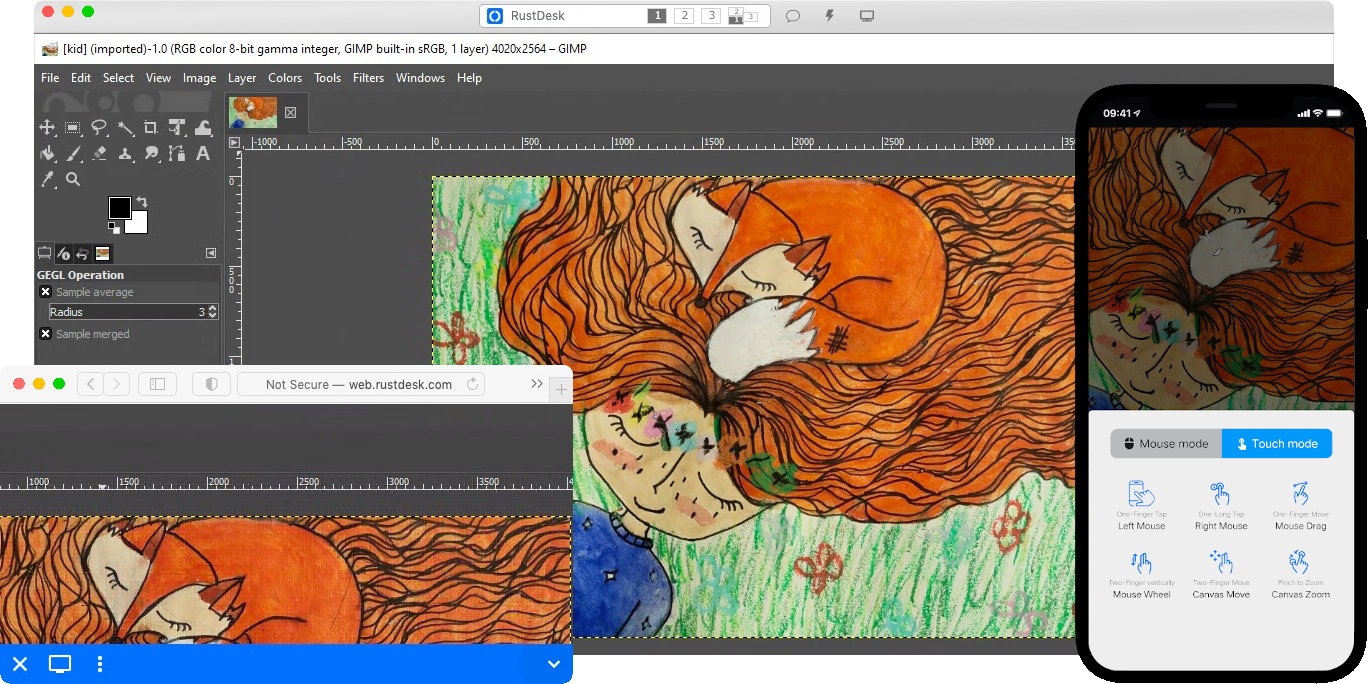
RustDesk welcomes contribution from everyone. See CONTRIBUTING.md for help getting started.

Dependencies
Desktop versions use Flutter or Sciter (deprecated) for GUI. This tutorial is for Sciter only, since it is easier and more friendly to start. Check out our CI for building the Flutter version.
Please download Sciter dynamic library yourself.
Raw Steps to build
-
Prepare your Rust development env and C++ build env
-
Install vcpkg, and set
VCPKG_ROOTenv variable correctly- Windows: vcpkg install libvpx:x64-windows-static libyuv:x64-windows-static opus:x64-windows-static aom:x64-windows-static
- Linux/macOS: vcpkg install libvpx libyuv opus aom
-
run
cargo run
Build
How to Build on Linux
Ubuntu 18 (Debian 10)
sudo apt install -y zip g++ gcc git curl wget nasm yasm libgtk-3-dev clang libxcb-randr0-dev libxdo-dev \
        libxfixes-dev libxcb-shape0-dev libxcb-xfixes0-dev libasound2-dev libpulse-dev cmake make \
        libclang-dev ninja-build libgstreamer1.0-dev libgstreamer-plugins-base1.0-dev
openSUSE Tumbleweed
sudo zypper install gcc-c++ git curl wget nasm yasm gcc gtk3-devel clang libxcb-devel libXfixes-devel cmake alsa-lib-devel gstreamer-devel gstreamer-plugins-base-devel xdotool-devel
Fedora 28 (CentOS 8)
sudo yum -y install gcc-c++ git curl wget nasm yasm gcc gtk3-devel clang libxcb-devel libxdo-devel libXfixes-devel pulseaudio-libs-devel cmake alsa-lib-devel gstreamer1-devel gstreamer1-plugins-base-devel
Arch (Manjaro)
sudo pacman -Syu --needed unzip git cmake gcc curl wget yasm nasm zip make pkg-config clang gtk3 xdotool libxcb libxfixes alsa-lib pipewire
Install vcpkg
git clone https://github.com/microsoft/vcpkg
cd vcpkg
git checkout 2023.04.15
cd ..
vcpkg/bootstrap-vcpkg.sh
export VCPKG_ROOT=$HOME/vcpkg
vcpkg/vcpkg install libvpx libyuv opus aom
Fix libvpx (For Fedora)
cd vcpkg/buildtrees/libvpx/src
cd *
./configure
sed -i 's/CFLAGS+=-I/CFLAGS+=-fPIC -I/g' Makefile
sed -i 's/CXXFLAGS+=-I/CXXFLAGS+=-fPIC -I/g' Makefile
make
cp libvpx.a $HOME/vcpkg/installed/x64-linux/lib/
cd
Build
curl --proto '=https' --tlsv1.2 -sSf https://sh.rustup.rs | sh
source $HOME/.cargo/env
git clone --recurse-submodules https://github.com/rustdesk/rustdesk
cd rustdesk
mkdir -p target/debug
wget https://raw.githubusercontent.com/c-smile/sciter-sdk/master/bin.lnx/x64/libsciter-gtk.so
mv libsciter-gtk.so target/debug
VCPKG_ROOT=$HOME/vcpkg cargo run
How to build with Docker
Begin by cloning the repository and building the Docker container:
git clone https://github.com/rustdesk/rustdesk
cd rustdesk
git submodule update --init --recursive
docker build -t "rustdesk-builder" .
Then, each time you need to build the application, run the following command:
docker run --rm -it -v $PWD:/home/user/rustdesk -v rustdesk-git-cache:/home/user/.cargo/git -v rustdesk-registry-cache:/home/user/.cargo/registry -e PUID="$(id -u)" -e PGID="$(id -g)" rustdesk-builder
Note that the first build may take longer before dependencies are cached, subsequent builds will be faster. Additionally, if you need to specify different arguments to the build command, you may do so at the end of the command in the <OPTIONAL-ARGS> position. For instance, if you wanted to build an optimized release version, you would run the command above followed by --release. The resulting executable will be available in the target folder on your system, and can be run with:
target/debug/rustdesk
Or, if you're running a release executable:
target/release/rustdesk
Please ensure that you run these commands from the root of the RustDesk repository, or the application may not find the required resources. Also note that other cargo subcommands such as install or run are not currently supported via this method as they would install or run the program inside the container instead of the host.
File Structure
- libs/hbb_common: video codec, config, tcp/udp wrapper, protobuf, fs functions for file transfer, and some other utility functions
- libs/scrap: screen capture
- libs/enigo: platform specific keyboard/mouse control
- libs/clipboard: file copy and paste implementation for Windows, Linux, macOS.
- src/ui: obsolete Sciter UI (deprecated)
- src/server: audio/clipboard/input/video services, and network connections
- src/client.rs: start a peer connection
- src/rendezvous_mediator.rs: Communicate with rustdesk-server, wait for remote direct (TCP hole punching) or relayed connection
- src/platform: platform specific code
- flutter: Flutter code for desktop and mobile